







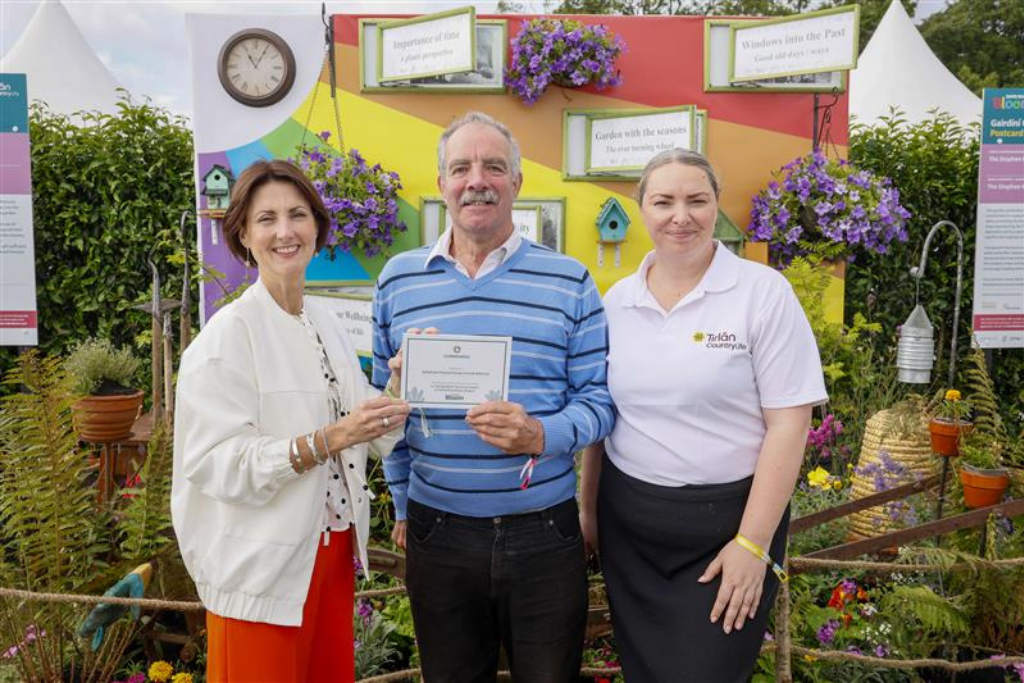
Our pop-up Postcard Gardens, which are proudly supported by Tirlán CountryLife, are one of the most popular attractions at Bord Bia Bloom. Built in one day, they provide amateur gardeners in communities, groups, and schools with a petite plot to showcase their stories, causes, or localities.
See the full list of winners here.
1: The Bat Corridor
Created by: Oranmore Tidy Towns, Oranmore, County Galway
While many of us enjoy a lively night out, bats depend on it for their survival. This thriving, after-dark town, created by Oranmore Tidy Towns, demonstrates how native Irish planting and protected darkness can support wildlife.
At this garden’s heart is a replica of Oranmore Castle, which is an active feeding site for five different bat species. The structure incorporates bat boxes and is surrounded by bat-friendly plants which are common in Oranmore, including hawthorn, blackthorn, elder, dog rose, rowan, and ivy. Other plants of significance for bats include evening primrose, honeysuckle, night-scented stock, jasmine, and sweet rocket.
2: The Living Bog
Created by: Leaving Certificate Applied Class, St Ciaran’s Community School, Kells, County Meath
The Leaving Certificate Applied Class at St Ciaran’s Community School in Kells, County Meath, combine their creative and practical skills to design and build this garden, which showcases the natural landscapes in their area.
A celebration of Ireland’s natural boglands, it seeks to inform visitors about native plants that are unique to peatlands, such as the carnivorous sundew. With its calm and relaxing mood, the garden encourages people to explore local, natural spaces that offer solace in a busy world.
3: A Landscape of Transition
Created by: Bagenalstown Community Garden, Bagenalstown, County Carlow
This Postcard Garden, created by the team in Bagenalstown Community Garden, presents a layered story of Carlow, reflecting on a lost wilderness and a landscape shaped by history, belief, and human hands.
It travels through the past to Mount Leinster in 1786, when Ireland’s last wolf was killed, through to the nearby Nine Stones, which are rich in folklore, and the 17th century Carlow Fence, the granite post-and-rail boundaries that are linked to Quaker settlers. Traversing Carlow’s rich landscape and recalling the deep bond between people and the wild, the garden asks, how can we reconnect with nature going forward?
4: Flower of Life Garden
Created by: North West Inner City Training & Development Project CLG
Brought to Bloom by the North West Inner City Training & Development Project, the Flower of Life Garden represents the journey of life. Our emotions are depicted in the segments of the geometric flower pattern, which merge the four elements of air, water, earth, and fire to become one.
Moving from the hardships of the outer circles, to the colourful inner circles, the garden illustrates the highs, lows, and challenges along life’s journey; how we recover, how we rehabilitate, and how we grow. At its centre, the symbolic bay tree signifies achievement and strength, while doves hanging from the arch represent peace, love, and the human spirit.
5: Bee Community
Created by: Tidy Towns Killaloe, County Clare
Tidy Towns Killaloe’s Bee Community Postcard Garden celebrates planting, place, and pollinators. Modelled on the community pollinator garden at the centre of the town, it features accessible, pollinator-centred planting that can be replicated in any community.
Verbena, geraniums, lupins, and sweet peas form a long-flowering, nectar-rich tapestry that support bees and demonstrate how simple, repeat combinations can create meaningful ecological impact in any community space. Hand-woven wicker bees are nestled among the flowers, symbolising both pollinators and community craftsmanship.
A mural of Killaloe, its bridge, and the plants featured, links biodiversity, heritage and local pride in this cohesive garden.
6: Éalú – The Getaway Garden
Created by: St. Joseph’s Adolescent School, Fairview, Dublin 3
This garden from St. Joseph’s Adolescent School is an inclusive and accessible space for young people in hospital for varying mental health and physical needs. It offers a place where they can escape the clinical hospital environment which can feel overwhelming and monotonous at times. Here they can collaborate and connect with peers through shared ownership and responsibility for the garden.
The mix of flowers, herbs, fruit, and vegetable planting offers visual interest and opportunities for activity throughout the year. It is a space to escape, to regulate and reflect, and to promote recovery by actively engaging with nature through gardening.
7: This is Us
Created by: Special Hands Activity Group, Kells, County Meath
Created by members of the Special Hands Activity Group, which supports approximately 200 children and young adults with intellectual delay and special needs, this garden represents the pathways members can take to learn new skills, integrate with the community, and develop lasting friendships. Through these paths, members can participate in a range of activities, from gardening and baking to horse riding and swimming.
Titled ‘This is Us’, the garden embodies the spirit of the group – it is a place where members can meet, create, feel empowered, and most importantly, have fun.
8: Yellow Meadow Kingdom
Created by: Celtic Eye Art Group and Karst Farming Network, East Galway and South Roscommon
This ant hill garden, which celebrates the vital role the yellow meadow ant plays within the Karst landscape, has been created by the Celtic Eye Group in collaboration with the Karst Farming Network, St. Hilda’s Services, and the Irish Wheelchair Association (Athlone). The installation combines recyclable materials, artwork, and native plants such as moss, ferns, foxglove, and thyme to reflect biodiversity, community and interconnection.
Yellow meadow ants act as eco-system engineers, building long lasting mounds that sustain plant and animal life. A symbol of ecological balance and renewal, they play an important role in protecting the landscape.
9: Community Tea
Created by: Cornafean GAA Health & Wellbeing Group, Cornafean, County Cavan
Community Tea is an ode to the community spirit of Cornafean GAA. Coordinated by members of the Health & Wellbeing Group, it is brought to Bloom with the support of the wider club community.
Named for the lively chats held in the club kitchen during community gatherings, the garden features a wall of planted teacups sourced from members, a chair made by the Women’s DIY class, and a raised planter crafted in the Men’s Shed, which is accessible to members with disabilities who participate in the weekly Star Camp. Many elements will relocate to the club’s community garden after Bloom.
10: Wish You Were Here
Created by: GAP Ireland’s GLAS community gardens, Dublin
Inspired by Green Living & Sustainability (GLAS) community gardens, which bring people of all ages and abilities together to learn about organic horticulture and gardening for biodiversity, this garden celebrates community and belonging. It reflects a space where volunteers from around the world garden side by side, sharing cultures, stories, and harvests.
Planted with vegetables, pollinator-friendly flowers, and dwarf fruit trees, the garden demonstrates what is possible in a small urban space. It is designed with wildlife in mind, with produce shared by humans, birds, and insects. The welcoming mural and map invites new volunteers to join the movement.
11: From Here We Bloom!
Created by: St Mathew’s National School, Sandymount, Dublin 4
This Postcard Garden illustrates how who we are is shaped by where we live and what we learn.
Created by the students of sixth class in St Matthew’s National School, Sandymount, it brings together parts of home, community, and school life. The plants, materials, and personal touches reflect the children’s own experiences, while symbols of learning show their growth, curiosity, and ideas.
This garden celebrates where we come from, and who we are growing up to be.
12: Seanchas and Sandhills
Created by: Kids of Tramore Pottery, Tramore, County Waterford
Honouring seanchas (old stories) and sandhills, this garden showcases the important grasses and plants that protect the beloved, but endangered, Tramore Sandhills.
A semi-circle of totem poles represents the local community as guardians of nature. Each is built using layered pieces of pottery made by local children in weekly pottery classes, demonstrating the transfer of craftsmanship from one generation to the next. Inside their fantastical ceramic creations are nestled amongst native coastal plants, driftwood, and lobster pots.
The garden celebrates the wonder that nature can inspire in the young while underlining how communities must be custodians of the natural world.
13: Unlocking Nature
Created by: Mountjoy Female Prison, Phibsboro, Dublin 7
Thoughtfully designed by prisoners in Mountjoy Female Prison, Unlocking Nature celebrates resilience and biodiversity. Incorporating native wildflowers and reclaimed timber for planting and bug hotels, each element is chosen to support local species and promote environmental learning.
More than a garden for prisoners, it is a symbol of growth, responsibility, and second chances, demonstrating how care for nature can cultivate hope, pride, growth, and positive change. Horticulture projects, such as this Postcard Garden for Bloom, provide teamwork exercises that help prisoners progress and showcase their talents.
14: Ash2020 Garden
Created by: Ash2020 Bicentenary CLG, Ashbourne, County Meath
This Postcard Garden represents the Ash2020 community garden in Ashbourne, highlighting biodiversity through pollinator-friendly planting, bird and insect boxes, and wild areas. Trees provide blossom, shade, and seasonal colour, including a living Christmas tree.
The ‘Batman, Robin, and Other Feathered Friends’ display adds fun and education. Street art reflects its history as a mail coach stop, while a Victorian bench invites relaxation. A symbolic portal to the future of Ashbourne suggests how spaces like this can inspire greener living, and a vision of a larger park shows how the town can be further enhanced for wellbeing, biodiversity, and community connection.
Postcard Gardens Sponsor
As Ireland’s second-biggest garden centre retailer, Tirlán CountryLife is proud to be 100% owned by farmers. It sources 90% of its plants from local Irish growers and nurseries and offers an in-house, qualified horticulturist in its garden centres, providing helpful tips and advice to novice and seasoned gardeners alike. Community is at the heart of everything at Tirlán CountryLife and it is delighted to continue its long-running relationship with Bord Bia Bloom by renewing its sponsorship of the Postcard Gardens. With a network of 15 garden centres, all of which operate in local communities, it is working with Bloom to spread the magic of the Postcard Gardens to an even wider audience.